AI Agent Evals: The Missing Layer Between Demo and Production
Most AI agents do not fail because the model is weak. They fail because teams ship demos without evals, tracing, guardrails, or regression loops.
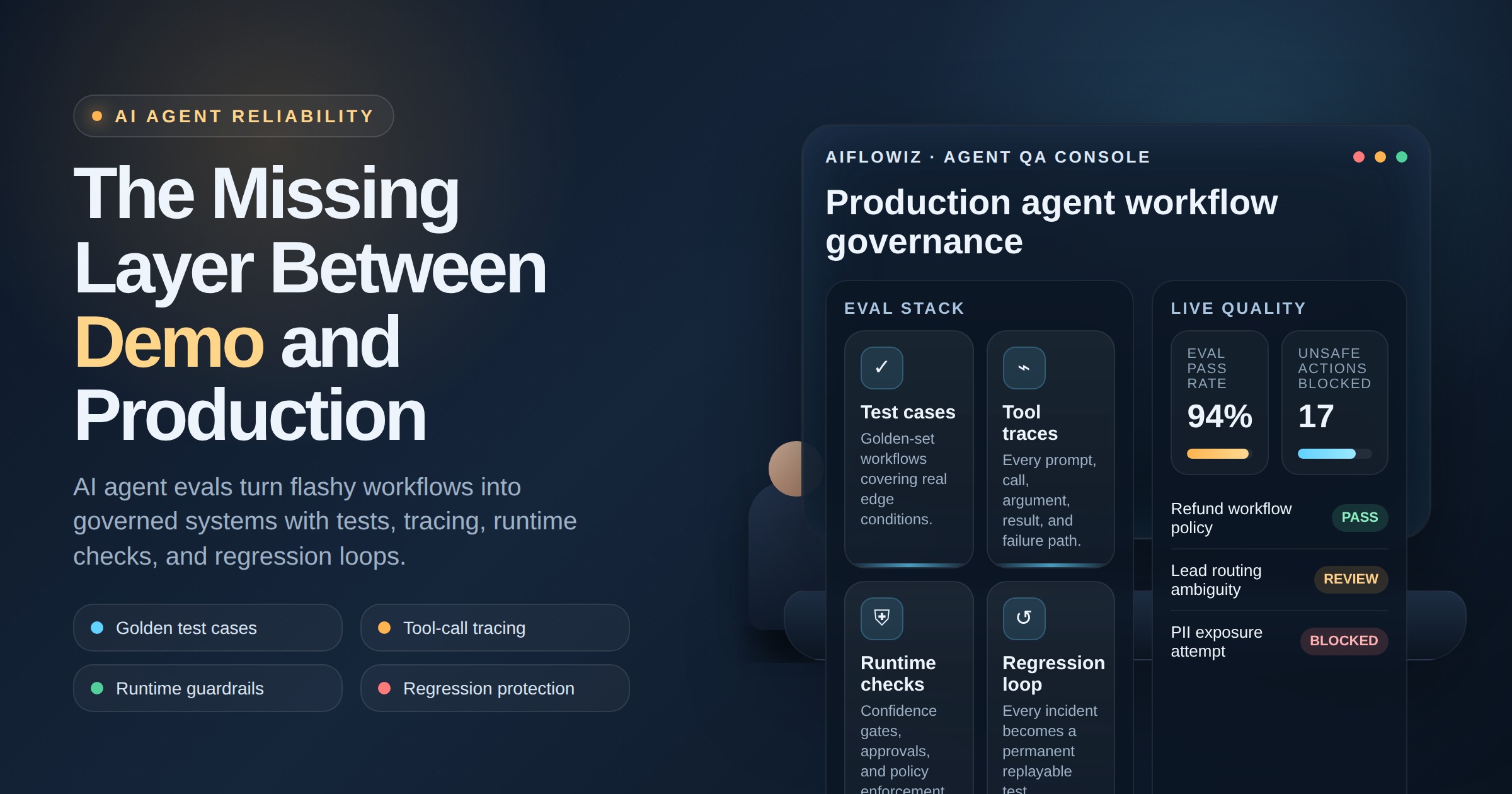
AI agents are not failing in production because the models are weak. They are failing because most teams still ship them like demos: no golden test set, no transcript tracing, no runtime checks, and no regression loop after incidents.
This is exactly where AIflowiz helps operations, support, and product teams: we build agent systems that are measured before they are trusted.
In 2026, the market signal is obvious. OpenAI is telling businesses to "specify, measure, improve." Anthropic is showing why multi-turn, tool-using agents need eval harnesses, not gut feel. LangChain’s 2026 survey says 57% of respondents already have agents in production, but quality is still the top blocker. Translation: the rush to ship happened first; the reliability layer is being built now.
Why evals became urgent this year
The old chatbot model was simple: ask a question, get a response, spot-check quality. That breaks once an agent starts calling tools, writing data, reading internal systems, or making decisions across multiple turns.
A support agent can now verify identity, search policy, trigger a refund, update a CRM, and draft the final reply. A sales agent can classify an inbound lead, enrich account data, route the deal, and draft follow-up. A document AI workflow can extract fields, validate them, escalate exceptions, and write back to the system of record. The moment the workflow touches state, "pretty good" stops being acceptable.
That is why the eval conversation changed. The question is no longer "can the model answer?" It is "can the system complete the workflow correctly, consistently, and safely?"
Where production agents actually break
Most teams do some prompting, a little manual QA, and maybe a few happy-path demos. Then the failures start showing up in places the demo never covered:
- tool calls use the wrong parameter or the wrong order
- memory carries forward the wrong context
- retrieval brings stale or irrelevant evidence
- approval gates are skipped under edge conditions
- the final answer sounds right while the underlying system state is wrong
This is the core trap of agent deployments: the transcript can look good while the business outcome is bad.
If your workflow handles leads, bookings, claims, onboarding, or support, those failures are not cosmetic. They turn into missed revenue, compliance risk, or cleanup work for humans.
The four-layer eval stack serious teams need
If you want an agent to survive real production traffic, you need more than one test. You need a stack.
1. Golden-set workflow tests
Start with 20-50 real examples from your own workflow: messy emails, incomplete forms, escalations, edge-case documents, and policy exceptions. Define what a correct result looks like before the model sees the task.
This is the fastest way to stop arguing in abstractions. Your team stops saying "it feels worse" and starts saying "it failed the refund rule on scenario 17" or "it routed enterprise leads into SMB by mistake."
2. Transcript and tool-call tracing
You need visibility into every step: what the model saw, which tool it called, what arguments it used, what came back, and how long each step took.
Without tracing, debugging agents is guesswork. With tracing, you can see whether the issue was prompt quality, missing context, bad retrieval, weak tool design, or model drift.
If you are already building approval-gated AI workflows in n8n, this layer is what stops your "automation" from becoming silent chaos.
3. Runtime guardrails and online checks
Offline tests are not enough. Production traffic always creates new edge cases. That is why reliable teams add serve-time checks for policy violations, low-confidence outputs, missing fields, or risky actions.
In practice, that means forcing human review when the agent is uncertain, blocking sensitive actions without approval, and logging every exception path. If your workflow handles sensitive business context, pair this with the architecture discipline from private LLM deployments, not just better prompts.
4. Post-incident regression loops
Every production failure should become a permanent test.
If an agent routed a high-value lead incorrectly, that exact pattern belongs in the regression suite. If a support workflow gave a compliant-looking but wrong answer, that case must be replayed automatically before the next release. Teams that skip this step keep paying for the same failure twice.
🔧 Want this running in your stack? A 7-Day Proof of Concept gives you a working agent workflow with evals, tracing, and approval boundaries on your real data.
The ROI math is more direct than most teams think
Here is a simple revenue-risk model for an inbound lead handling agent:
- 800 inbound leads per month
- 4% mishandled because routing, qualification, or follow-up logic breaks
- that is 32 leads touched incorrectly
- if 10% of those would have closed
- and first-sale value is $1,500
That is 3.2 deals × $1,500 = $4,800/month of exposed revenue from a workflow that "mostly works."
Now add the human cleanup cost:
- 32 bad cases × 15 minutes manual correction = 480 minutes
- 480 minutes = 8 hours
- 8 hours × $35/hour ops cost = $280/month in direct rework
So the same weak eval posture can quietly burn $5,080/month between lost conversions and cleanup. That is why evals are not a research nice-to-have. They are an operations control layer.
What AIflowiz would actually build here
This is the production pattern we recommend for most agent workflows:
- map the business process and define success/failure states
- build a golden dataset from real workflow examples
- wire tracing across prompts, tools, memory, and outputs
- add offline evals before release and online checks after release
- enforce approval gates for sensitive actions
- convert every incident into a regression test
For teams building deeper agent systems, the same logic applies whether the workflow runs in CRM automation, support operations, document processing, or a more advanced memory-and-tools architecture like Hermes-style agent systems.
The stack changes. The principle does not: don’t trust the demo, trust the measured system.
Frequently asked questions
How many eval cases do we need to start?
You do not need hundreds on day one. A strong first version is usually 20-50 real workflow cases pulled from production, support tickets, failed automations, or high-value edge cases. Start small, then grow the suite every time the system fails in a new way.
Are offline evals enough for production agents?
No. Offline evals catch regressions before release, but production traffic creates new distributions and edge conditions. Serious systems combine offline testing, runtime checks, tracing, and periodic human review.
What should we evaluate: the final answer or the workflow steps?
Both. The final answer matters, but agent systems can produce a convincing answer while still mutating the wrong records, skipping approvals, or using the wrong tool inputs. Evaluate the transcript, tool usage, and end-state outcome together.
Can this work with our current stack?
Yes, if your workflow already lives in tools like a CRM, help desk, ERP, Google Workspace, or an automation layer such as n8n. A Free 30-Minute AI Audit is usually the fastest way to map where evals, tracing, and guardrails should sit in your current system.
When should we use a private or local model instead of a hosted API?
Use private or local deployment when data residency, regulated information, or internal confidentiality make public API routing a problem. In those cases, the eval and guardrail layer matters even more because you are taking on more of the runtime responsibility yourself.
The real shift
The winner in agent deployments will not be the team with the flashiest demo. It will be the team that can prove the workflow works under pressure, catch failures before users do, and keep improving after release.
If you already have an agent prototype but do not trust it in production, that is the gap. Book a Free 30-Minute AI Audit and AIflowiz will map the eval stack, approval boundaries, and production workflow needed to make it reliable.