Hermes Architecture Explained: Memory, Context, and Gateways
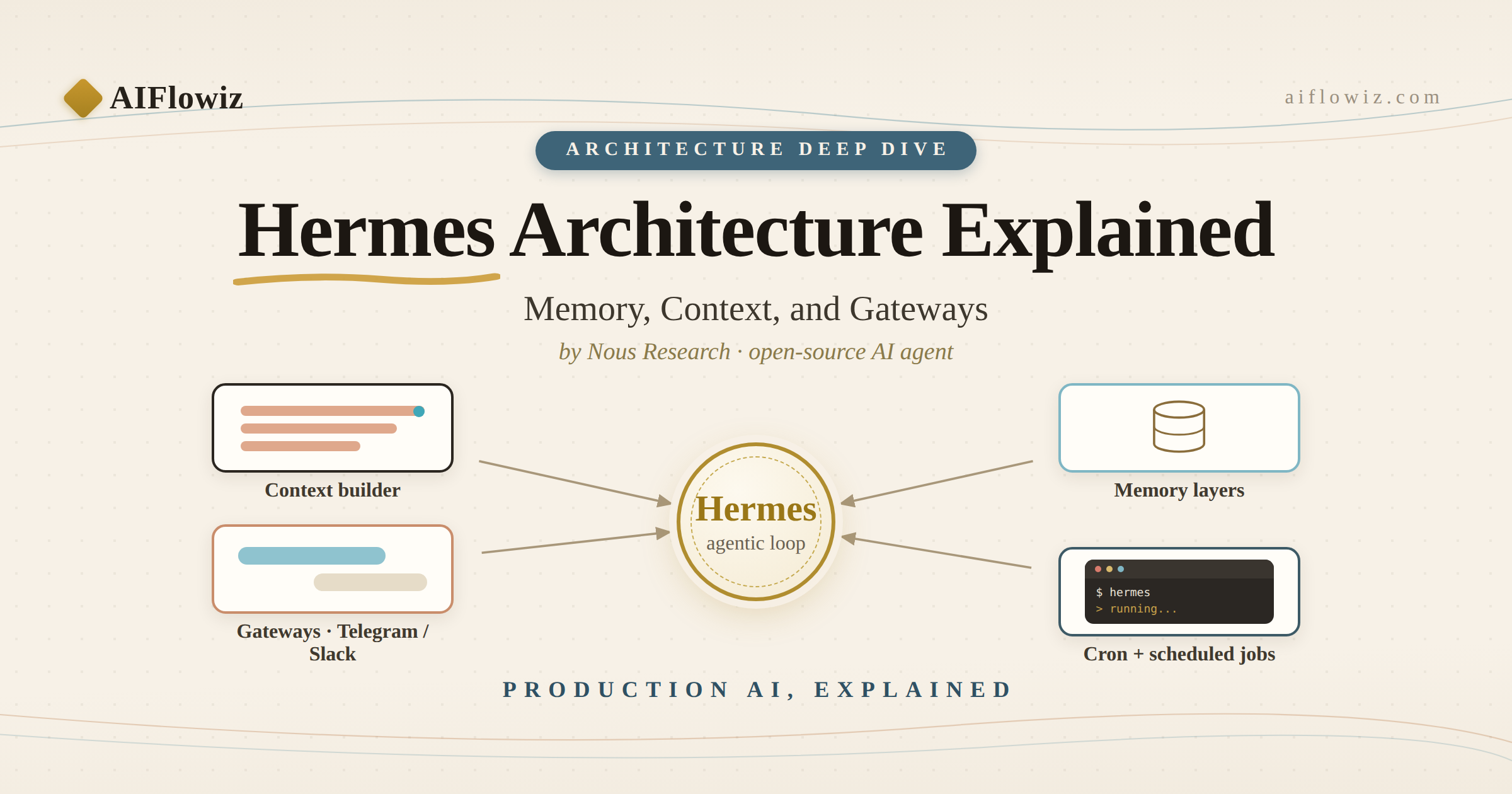
Hermes is more than a chatbot wrapper. This walkthrough explains the agentic loop, context-building system, memory layers, messaging gateway, and cron architecture that make Hermes usable for real operator workflows.
Hermes Architecture Explained: Memory, Context, and Gateways
Most AI agent demos hide the part that actually matters in production: how the system rebuilds context, decides what to remember, routes messages across channels, and keeps automation from turning into a pile of stateless prompts. Hermes is interesting because its architecture is opinionated about exactly those problems.
If you are evaluating Hermes for internal ops, support automation, AI agents with real tools, or a multi-channel operator workflow, you should care less about the model picker and more about the runtime design. The real question is not “can Hermes call tools?” It is “how does Hermes keep state, route work, compress context, and deliver actions safely across sessions and channels?”
That is where Hermes becomes commercially useful.
The core of Hermes is the agentic loop
At the center of Hermes is a simple but production-relevant loop:
- user message arrives
- Hermes rebuilds context for that session
- the full prompt goes to the LLM
- the LLM can call tools
- Hermes loops until the task is done
- a final response is returned
- a memory-update pass analyzes whether anything from the conversation should be persisted
That sounds obvious, but it matters.
A lot of “agent” products are still just chat wrappers with thin tool calling bolted on. Hermes is closer to an execution runtime. It keeps reassembling context, executing tool calls, and deciding what deserves to survive past the current turn.
For a business workflow, that is the difference between a novelty assistant and an operating layer.
Hermes has three access paths
Hermes can be reached through three main paths:
- CLI via the
hermescommand (new to Hermes? Start with our step-by-step setup guide) - the messaging gateway through Telegram, Slack, email, WhatsApp, Discord, SMS, and similar channels
- API-based access for software integrations
This is more important than it looks.
The same agent runtime can serve a founder from the terminal, a support workflow from Telegram, and an internal automation through an API route. That lets one system support multiple operating surfaces without rewriting the whole stack per channel.
For AIflowiz-style deployments, that means the architecture can support:
- a builder or operator using Hermes directly in CLI
- managers receiving summaries and approvals in chat
- app workflows hitting Hermes programmatically
That is a stronger model than “one chatbot per interface.”
Context in Hermes is built from markdown files plus live history
One of Hermes’ most useful design choices is that core context is deliberately plain.
The major persistent context files are markdown:
soul.mdfor personality and base behavioruser.mdfor learned facts about the usermemory.mdfor arbitrary learned facts, environment details, workflow notes, and durable observations
These are appended right after the system prompt, followed by skill content, tool descriptions, and message history or compressed session summaries.
That makes the system easier to inspect than many agent frameworks.
Instead of hiding “memory” inside a black-box vendor abstraction, Hermes exposes a readable context layer that can actually be reasoned about. If an agent starts behaving strangely, you have somewhere concrete to look: personality, user facts, learned memory, skill payloads, and recovered session history.
That is operationally valuable.
Hermes memory is not one thing. It is three layers.
People talk about “memory” like it is a single feature. In Hermes, it is better understood as three separate layers.
💡 Key takeaway: Hermes memory = inspectable markdown files + searchable SQLite session history + optional external providers. Start with the internal layers, add external memory only when a workflow proves it needs it.
1. Markdown memory files
The first layer is the simplest: markdown-based memory living in user.md and memory.md. This is where durable facts and learned notes can be stored in plain language.
This layer is lightweight, inspectable, and practical. It is good for facts such as user preferences, environment details, workflow conventions, and persistent notes that should influence future behavior.
2. Internal SQLite session history
The second layer is the internal SQLite session store.
Hermes keeps full session transcripts keyed to gateway or session identifiers, and it also maintains a plain-text surface that can be searched for similarity and retrieval. That means Hermes is not only relying on manually curated memory; it also has a searchable record of what actually happened in prior sessions.
This is a big deal for production AI.
Many systems fail because they either remember too little or remember the wrong thing. SQLite-backed transcript recall gives Hermes a second lane: not just “what should be permanently remembered,” but also “what was previously said or done in related work?”
That supports better continuity without forcing every detail into permanent memory.
3. External memory providers
The third layer is optional external memory providers such as Mem0, SuperMemory, and Honcho.
These are off by default. When enabled, Hermes can query external memory starting from the second message onward. That design choice is sensible: on the first message, the agent does not yet know enough about the task to form a meaningful retrieval query.
The practical takeaway is this: Hermes supports internal memory first, then richer external memory if your workflow needs it.
That matters for businesses that want a phased rollout.
You can start with internal transcript history and markdown memory, then add external memory only when your workflows justify the complexity.
Context compression is one of the real architecture features
Context compression is where agent frameworks either become resilient or start collapsing under their own history.
Hermes checks for compression pressure in two places:
- before every turn, using a cheap approximation based on character count
- again if the model actually returns a context-overflow error using real usage numbers from the provider response
By default, compression kicks in at roughly 50 percent of the context window, though that threshold is configurable.
The important detail is not just that Hermes compresses. It is how it compresses.
The compression prompt is designed to output structured sections such as:
- goal
- constraints
- completed actions
- active state
- key decisions
- resolved questions
- relevant files
- critical context
- previous summaries
- next turns
That structure is much more operational than a minimalist “conversation summary.”
For business use, this means Hermes is better suited to long-running workflows where state has to survive without becoming mush. A good compression layer lets an agent keep continuity across implementation sessions, debugging runs, publishing workflows, and multi-turn automation without reloading everything from scratch.
The messaging gateway is what makes Hermes operational
The gateway is where Hermes stops being just a terminal agent.
Hermes runs a persistent async gateway loop across integrations. Depending on the platform, that can mean webhooks, polling loops, or websockets. But the architectural point is the same: Hermes can listen on multiple channels while rebuilding full context on each inbound message.
The gateway itself does not need to keep a magical live conversation object in memory. Instead, inbound messages map to a session identifier such as:
telegram:<id>
That session ID is then used to recover message history from SQLite and reconstruct context from scratch for that conversation.
This is cleaner than pretending the gateway is the source of truth.
It means the transport layer stays relatively simple while the real continuity lives in the session system.
For practical operations, the gateway also supports interruption and steering patterns. If a run is active, one command can interrupt it, another message can queue behind it, and steering can redirect the current run mid-stream.
That is useful for real operators because production work is messy. People change their minds, reprioritize, and interrupt flows all the time.
Cron scheduling turns Hermes into a workflow engine
Hermes includes its own internal cron loop rather than delegating everything to OS cron.
On a regular tick, Hermes reads scheduled jobs, checks what is due, executes jobs, and writes results into per-job output files. Notifications go directly to the configured home channel.
That design matters because it keeps automation close to the agent runtime.
Instead of bolting an external scheduler onto a stateless endpoint, Hermes can run a scheduled task in the same architecture that already knows about skills, tools, delivery targets, and session-aware execution.
For a business, that unlocks real use cases such as:
- daily AI ops briefings
- scheduled research runs
- CRM follow-up nudges
- support backlog summaries
- recurring lead intelligence reports
- publishing workflows with human review checkpoints
This is the point where Hermes becomes more than an assistant. It starts looking like an agentic workflow layer.
What this means for teams evaluating Hermes
The strongest part of Hermes is not that it supports models, tools, or messaging. Plenty of systems claim that.
The stronger point is that Hermes combines:
- an explicit agentic loop
- inspectable context files
- internal session recall
- optional external memory layers
- structured compression
- multi-channel delivery
- built-in scheduling
That stack is exactly what business AI teams need if they are trying to move from “chat with AI” to “run AI inside operations.”
If you are designing support agents, internal copilots, workflow operators, or multi-channel business automations, this architecture gives you a more realistic foundation than a plain chat UI with a plugin button.
The real buyer question
If you are evaluating Hermes or any similar agent stack, the question is not whether the model is smart enough in a single prompt.
The real question is this:
How does the system hold state, recover context, remember the right facts, compress long-running work, route messages across channels, and schedule repeatable execution without turning into chaos?
That is the architecture question.
And that is the part that decides whether an AI agent helps your business or becomes another fragile demo.
If your team wants a Hermes-style agent setup with memory boundaries, context control, messaging delivery, and production workflow automation, AIflowiz can design the architecture, ship a 7-day proof of concept, and harden it for real operations. Book a free AI audit and we will map this architecture onto your actual workflows.