The AI Trend That Matters: Workflow Infrastructure
Today’s strongest AI signal is practical: agents, RAG, voice, and n8n workflows are moving into real business operations. The opportunity is to turn one painful manual process into a measured AI system.

The AI trend that matters today is not smarter chat. It is AI moving into the workflow layer: agents that call tools, RAG systems that answer from company knowledge, voice interfaces that handle intake, and automation stacks that quietly remove repetitive work from operations.
The shift: from AI assistant to AI operator
For the last two years, most companies tested AI as a side tool: a prompt window, a support draft, a summarizer, a demo chatbot. That phase is ending. The useful work is now happening where AI connects to the systems a team already uses — CRM, inbox, spreadsheets, helpdesk, databases, internal docs, calendars, and warehouse tools.
That is why the strongest signal from today’s AI ecosystem is workflow infrastructure. Recent open-source activity around agent automation, n8n workflows, RAG applications, and offline voice transcription all points in the same direction: businesses want AI that does the work, not AI that only talks about the work.
💡 The practical question is no longer “Which model is best?” It is “Which workflow should AI own first, and how do we measure the business result?”
Trend 1: agents are useful when they have tools
AI agents become valuable when they stop being isolated chat sessions and start using real tools: searching internal docs, opening tickets, updating records, sending structured emails, calling APIs, checking policy, and asking a human when confidence is low.
- A sales agent can qualify inbound leads, enrich the company profile, and draft the follow-up.
- An operations agent can watch an inbox, classify requests, extract fields, and route work to the right system.
- A support agent can answer from product docs, escalate edge cases, and create clean summaries for humans.
- A finance/admin agent can parse documents, validate fields, and push exceptions into review.
This is exactly where AIflowiz fits: build the agent around the workflow, not the other way around. The model is only one component. The real system includes tools, memory, permissions, evals, retries, human handoff, and monitoring.
Trend 2: n8n is becoming the AI control plane
The rise of n8n-style AI workflow repos is not accidental. Teams want a visual and maintainable way to connect triggers, APIs, LLM calls, approvals, and fallback paths. Instead of building a giant custom app first, they can ship a workflow that proves ROI in days.
- Pick one painful manual process with clear volume: intake, qualification, reporting, support, document review, or follow-up.
- Map the inputs, decisions, systems, and human approval points.
- Use n8n or a lightweight workflow layer to connect the process end-to-end.
- Add AI only where it improves classification, extraction, reasoning, generation, or routing.
- Instrument the workflow: time saved, error rate, escalation rate, cost per run, and user satisfaction.
✅ A good AI workflow does not replace the whole business process on day one. It removes the most expensive manual step, proves ROI, then expands.
Trend 3: RAG chatbots are becoming revenue systems
RAG is no longer just chat with your PDF. When built correctly, it becomes a revenue and support layer: answer buyer questions, capture intent, recommend the next action, and hand off to a human with context instead of dumping a cold lead into a form.
For AIflowiz clients, the useful version is usually a focused chatbot trained on product docs, FAQs, pricing rules, onboarding flows, and objection-handling notes. It should not pretend to know everything. It should answer from approved sources, show confidence thresholds, and capture qualified leads when the visitor is ready.
- For support: reduce repetitive tickets and create cleaner human escalations.
- For sales: qualify visitors and route hot leads faster.
- For onboarding: answer setup questions from docs and internal SOPs.
- For regulated teams: run private RAG with local/on-prem LLMs where data cannot leave the environment.
Trend 4: voice AI and local AI are becoming buying triggers
Offline and privacy-first voice tools are getting attention because voice is one of the highest-friction parts of business operations: calls, meetings, intake, field notes, appointment booking, and follow-up. Once voice becomes structured data, automation becomes possible.
At the same time, local and on-prem LLM demand keeps growing because many teams cannot send sensitive data to a public model endpoint. This is where Ollama, vLLM, quantized models, private RAG, and internal dashboards become practical infrastructure — especially for healthcare, finance, legal, and enterprise operations.
What AIflowiz would build first
The right first AI project is not the flashiest one. It is the workflow with enough repetition, enough pain, and enough measurable upside. For most teams, that means one of these systems:
- AI intake workflow — capture, classify, enrich, route, and summarize inbound requests.
- RAG sales/support chatbot — answer from approved knowledge and capture qualified leads.
- Document AI pipeline — extract fields, validate rules, push exceptions to humans.
- Voice AI workflow — transcribe, summarize, qualify, and trigger follow-up actions.
- Local AI setup — private RAG and internal agents for sensitive company data.
📌 The best 7-day PoC has one success metric: hours saved, faster response time, higher lead capture, fewer errors, or lower cost per operation.
How to deploy without creating AI chaos
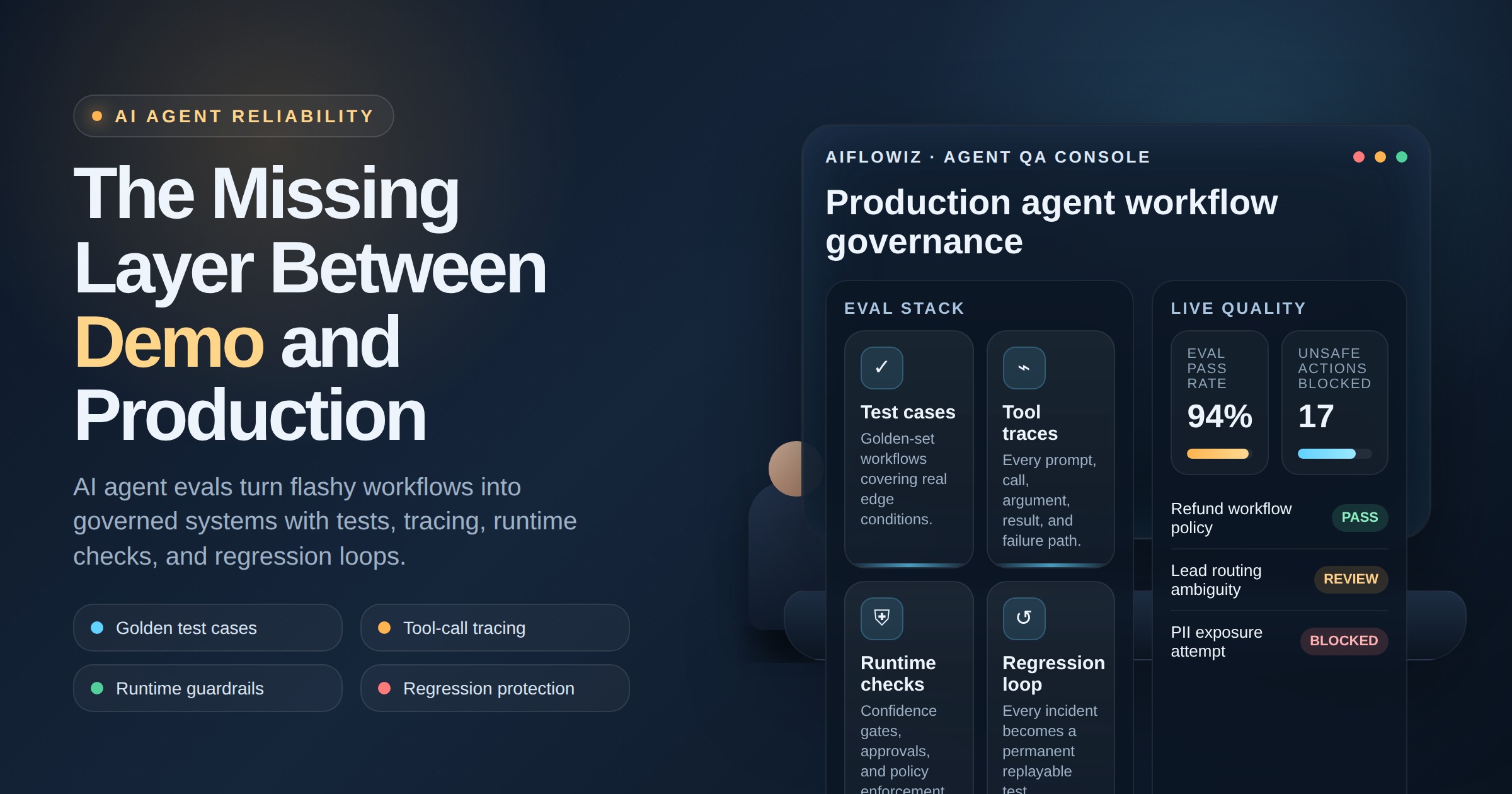
The failure mode is predictable: a company wires an LLM into a business process, gets a few impressive demos, then discovers edge cases, hallucinations, runaway costs, and no clear owner. Production AI needs guardrails from day one.
- Add evals for common and risky cases before launch.
- Set confidence thresholds and human-in-the-loop fallback.
- Trace every model call, tool call, and workflow decision.
- Cap cost per run and monitor token spend.
- Keep prompts, retrieval sources, and workflows versioned.
- Start narrow, prove ROI, then expand the automation surface.
Today’s AI trend is clear: the winners will not be the teams with the most AI subscriptions. They will be the teams that turn one painful workflow into a measured AI system, then repeat that pattern across the business. If you want to find the first workflow AI should own in your company, book a free AIflowiz audit — we will map the ROI, tell you what not to build, and ship a 7-day proof-of-concept if the opportunity is real.