People See Bigger Models. Smart Businesses See Broken Workflows.
Most of the market sees bigger context windows, stronger benchmarks, and smarter AI agents. Smart operators see the harder truth: if the workflow is messy, a better model does not fix it — it scales the mess faster.

People usually see what they want to see.
In AI, that means the market sees the headline: bigger context windows, stronger benchmarks, more capable agents, better coding performance, and the promise of longer autonomous work. What many teams do not want to see is the part that actually determines whether AI makes money or burns it: broken workflows, vague approvals, weak guardrails, and no operational ownership.
That is the real story behind the latest frontier-model wave.
Yes, models are getting better. But for most businesses, the highest-leverage question is not Which model is smartest? It is What happens when this model touches a real workflow with real costs, real customers, and real failure modes?
What most people notice first
The latest model launches make the same kind of impact for a reason. They are easy to sell visually.
People notice:
- the 1M-token context window
- the benchmark charts
- the coding scores
- the longer task execution claims
- the promise that the model can now handle more of the work end to end
Those improvements matter. They expand what is technically possible.
But they also create a dangerous illusion: that more model intelligence automatically translates into more business value.
It does not.
A better model inside a bad workflow is still a bad workflow — just faster, more confident, and sometimes more expensive.
What smart operators notice instead
Smart businesses look past the benchmark screenshot.
They ask harder questions:
- What task should this model own?
- Which systems is it allowed to touch?
- What is the escalation path when confidence is weak?
- What happens when the model loops, stalls, or chooses the wrong tool?
- Who approves sensitive actions?
- What is the per-task cost ceiling?
- How do we audit outputs after deployment?
That is the difference between AI as a demo and AI as an operating layer.
Most AI projects fail quietly because nobody designed the system around the model. The team just dropped a strong model into a weak process and hoped capability would compensate for bad structure.
It never does.
Bigger context often hides bigger operational debt
A large context window sounds like freedom. In practice, many teams use it as a place to hide workflow problems they never solved.
When someone says, “the model can read everything now,” that can mean:
- source documents were never normalized
- duplicate knowledge lives across disconnected systems
- no one defined a trusted source of truth
- sensitive actions are not separated from low-risk tasks
- prompt logic is doing the job that application logic should handle
- token spend is growing without routing discipline
In other words, the model is carrying organizational mess that should have been fixed upstream.
That is why bigger context is not automatically better operations. Sometimes it just gives chaos a larger container.
Where the real ROI comes from
The companies getting actual value from AI are usually not the loudest ones online. They are the ones doing the boring but critical design work.
They use stronger models selectively.
A practical production pattern looks like this:
1. Use premium intelligence where complexity is real
Reserve your strongest model for tasks like:
- complex document review
- multi-step reasoning across internal knowledge
- exception handling in operations
- higher-stakes agent decisions
- difficult coding, analysis, or workflow-debugging tasks
2. Keep routine work cheap, structured, and deterministic
Do not waste frontier-model spend on tasks that should be simple.
Use lower-cost models or deterministic automation for:
- tagging
- classification
- extraction from standardized inputs
- templated responses
- structured field mapping
- database updates and routine handoffs
3. Put boundaries around every autonomous step
Every production AI workflow should define:
- approved tools and tool scope
- timeout and retry rules
- budget caps
- logging and observability
- human approval checkpoints
- fallback logic when the primary model is unavailable or overkill
That is where trust is built.
The market is distracted by intelligence. The real problem is control.
This is the uncomfortable truth many teams would rather avoid: intelligence is improving faster than operational discipline.
That gap is where most AI waste happens.
A business buys into the promise of smarter agents, but underneath the demo there is no real orchestration layer, no eval loop, no routing policy, and no cost discipline. So the system looks impressive in testing and unstable in production.
The model is not the only product. The workflow is the product.
If the workflow cannot:
- validate inputs
- route edge cases
- separate cheap tasks from expensive ones
- escalate uncertainty
- preserve auditability
- protect sensitive data
then the deployment is not mature, no matter how impressive the model looks.
This is where AIflowiz fits
At AIflowiz, we do not treat model selection as the whole strategy. We treat it as one layer of the system.
What businesses actually need is a governed production design that connects intelligence to execution without creating new operational risk.
That usually means:
- mapping the real business bottleneck before choosing the AI pattern
- building n8n or API-based workflow orchestration across tools and internal systems
- adding RAG only where live knowledge retrieval is necessary
- using Document AI where extraction must feed clean downstream actions
- adding approval gates for sensitive decisions
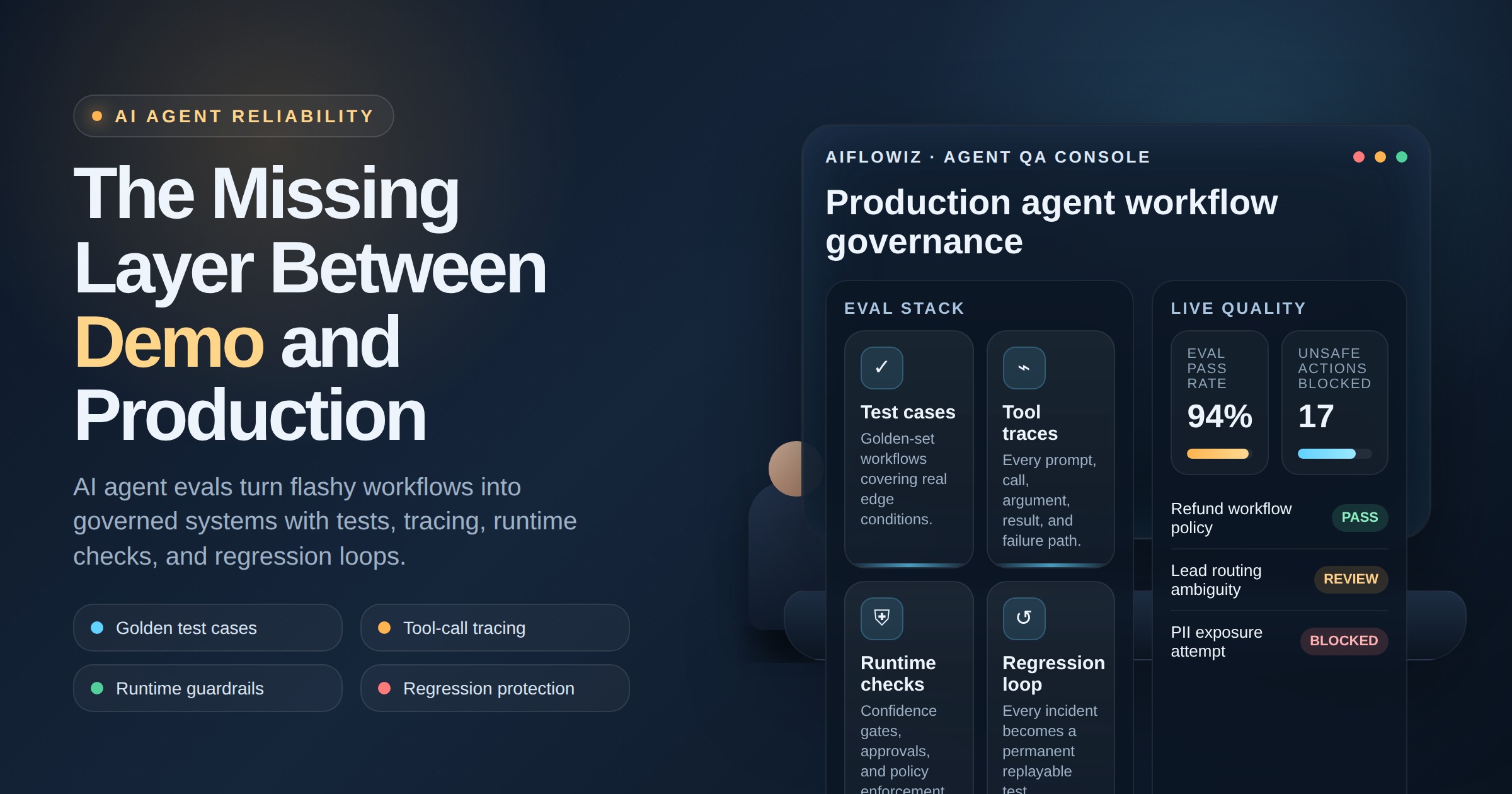
- implementing evals, logs, and monitoring so quality does not drift silently
- using private or controlled deployment patterns where data sensitivity demands it
This is how AI stops being a novelty and starts becoming infrastructure.
The takeaway businesses need to hear
Most people will keep seeing what they want to see.
They will see bigger models and assume the hard part is solved.
But smart operators see the hidden truth: the real bottleneck is rarely model capability alone. It is workflow design, routing, governance, cost control, and operational ownership.
That is why the winning move is not to chase the biggest model headline. It is to build the system that makes model intelligence usable, measurable, and safe.
If your team is exploring AI agents, RAG systems, Document AI, workflow automation, or private production AI, AIflowiz can help you design the workflow that turns model capability into actual business leverage.
CTA: Book a free AI audit with AIflowiz or start a 7-day PoC to identify where stronger AI models will create real ROI — and where better workflow design matters more than a bigger benchmark.