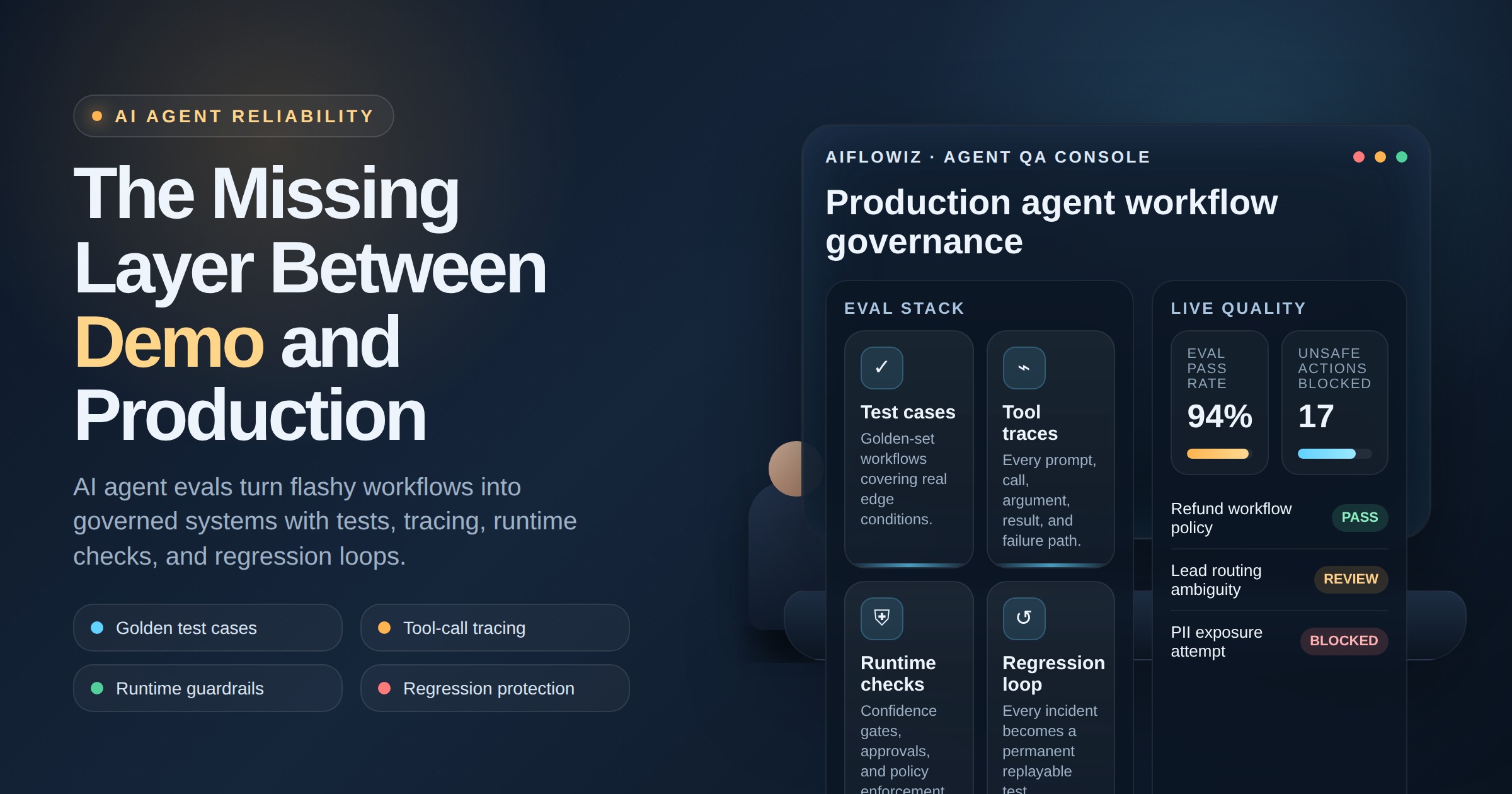
AI Agent Observability: Control the Action, Not the Demo
AI agents fail quietly when nobody can see which tool they used, why they acted, or where the cost came from. Production observability turns agent behavior into traces, evals, alerts, and rollback paths operators can trust.

A demo agent looks impressive when it completes one clean task. A production agent becomes risky the moment it can touch tools, data, customers, budgets, or internal systems without leaving a usable trail. The hidden work is not making the agent act. The hidden work is making every action bounded, observable, and reversible.
The business pain: agents create invisible operational risk
Most teams discover the problem after the first exciting pilot. The agent can draft emails, update a CRM, search a knowledge base, open tickets, summarize calls, or trigger workflows. Then an operator asks a practical question: what exactly did it do, why did it do it, and how do we know it will not do the wrong thing again tomorrow?
That is where the demo breaks. Traditional application monitoring tells you whether an endpoint is up. It does not explain whether an agent chose the right tool, retrieved the right context, followed policy, stayed inside budget, escalated at the right time, or invented a shortcut no one approved.
If the business cannot inspect the path, it cannot trust the output. And if it cannot trust the output, the agent gets pushed back into toy use cases.
The production gap is not intelligence. It is traceability.
The AI opportunity: turn agent behavior into an operating system
AI agent observability gives teams a way to see the full chain of behavior: prompt, context, retrieved records, tool calls, intermediate reasoning artifacts where appropriate, final action, cost, latency, evaluation score, human override, and downstream business result.
This matters because agents are not single API calls. They are multi-step workflows that make decisions under uncertainty. They need the same operational discipline as any other business-critical system, plus extra controls for language, retrieval, tool permissions, and policy boundaries.
For AIflowiz clients, the goal is usually not to “monitor AI” in the abstract. The goal is to make a revenue, support, finance, or operations workflow safe enough to automate beyond the demo.
The implementation architecture
A reliable agent observability stack has four layers.
1. The trace layer
Every run should produce a readable timeline:
- who or what started the run
- which prompt and policy version was used
- what data was retrieved
- which tools were called
- what each tool returned
- what the agent decided next
- what final output or action was produced
Without this layer, incidents become guesswork. With it, operators can replay a failed run, compare it to a successful one, and fix the system instead of blaming the model.
2. The evaluation layer
Production agents need checks before, during, and after execution. Some evals are deterministic: did the agent call an allowed tool, include a required field, or stay under a cost cap? Others are judgment-based: did it answer from approved sources, classify the customer correctly, or escalate when confidence was low?
The best evals are tied to workflow outcomes, not vanity scores. A support agent should be measured on correct resolution, safe escalation, and refund policy compliance. A sales agent should be measured on qualified handoffs, CRM completeness, and follow-up accuracy.
3. The guardrail layer
Guardrails are not a single moderation filter. They are a set of boundaries around the workflow:
- tool permissions by role and scenario
- retrieval boundaries by document type and customer segment
- human approval gates for irreversible actions
- cost and latency caps
- sensitive-data redaction
- fallback paths when context is missing
- rollback instructions for failed actions
The agent should not be allowed to improvise around these boundaries. If it cannot continue safely, it should stop, explain the blocker, and hand off.
4. The feedback layer
Every failure should improve the system. Missed retrieval, bad classification, tool errors, user corrections, approval denials, and customer escalations should flow back into prompts, knowledge base updates, eval sets, and workflow rules.
This is where most deployments stall. They collect logs but never convert them into operating improvements. Observability only creates ROI when it becomes a feedback loop.
ROI: fewer failed automations, faster rollout, cleaner ownership
The financial case is simple: observability reduces the cost of trust. When leaders can see how an agent behaves, they can expand automation into higher-value workflows without guessing.
A measurable rollout should track:
- manual hours removed per workflow
- percentage of runs completed without human intervention
- percentage escalated correctly
- cost per successful run
- error rate by tool or intent
- time to diagnose incidents
- approval turnaround time
- revenue, ticket, or invoice throughput created by the agent
The strongest ROI usually comes from controlled partial autonomy. Let the agent handle intake, routing, drafting, research, enrichment, and low-risk updates. Keep irreversible actions behind approval until the eval history proves the path is stable.
Risks and guardrails to handle before launch
The biggest risk is giving the agent tool access before defining ownership. Someone must own the policy, the prompt, the eval set, the tool permissions, the incident process, and the business metric.
Other risks are predictable:
- Silent failure: the agent appears successful but creates downstream cleanup.
- Permission creep: tool access expands faster than governance.
- Cost drift: multi-step runs become expensive under real volume.
- Context leakage: retrieval exposes data the workflow should not use.
- No rollback: the agent changes a system of record without a repair path.
A production design should include staged rollout, audit logs, sampled human review, alert thresholds, approval gates, and a clear kill switch.
What AIflowiz builds in a 7-day PoC
A practical PoC does not need to automate the whole company. It should prove one workflow boundary.
For example, AIflowiz can build an agent that monitors a shared inbox, classifies requests, retrieves account context, drafts the next action, updates a CRM field only when rules pass, and escalates edge cases to a human owner. The PoC includes traces, eval checks, cost reporting, approval gates, and a dashboard that shows what the agent did.
That gives the team a decision: expand, tighten, or stop. No black box. No blind trust.
A production agent needs an operating room, not a black box. If your business is ready to move an agent from demo to workflow, book a free AI audit or start a 7-day AI automation PoC with AIflowiz.