AI Agent Handoffs Without Losing Operational Control
AI agents create value when they remove the dead space between teams, tools, and approvals. The win is not full autonomy; it is controlled handoff automation with clear boundaries, logs, and human escalation.

The most expensive part of many operations teams is not the work itself. It is the handoff: the Slack message waiting for context, the CRM record that never gets updated, the approval buried in someone’s inbox, and the customer stuck between systems. AI agents can remove that drag, but only if they are designed as controlled workflow operators instead of unrestricted digital employees.
The business pain: work stalls between systems
Founders and ops leaders usually see the same pattern: sales promises something, support discovers missing information, finance needs approval, and delivery waits for a status update. Everyone is busy, but the process still moves slowly because no one owns the space between tools.
That is where buyer intent is strongest. Teams are not looking for “an AI agent” in the abstract. They want fewer manual follow-ups, faster response times, cleaner records, and less dependency on one person remembering every edge case.
💡 The first agent worth building is rarely a fully autonomous worker. It is a controlled handoff map that moves work to the next correct step with evidence, permissions, and a fallback path.
The architecture: agent, tools, approvals, and audit trail
A production handoff agent starts with event triggers: new lead, delayed ticket, missing invoice field, failed webhook, unsigned proposal, or stale CRM stage. The agent reads the context, checks policy, takes the allowed action, and records what happened.
- Trigger layer — Slack, HubSpot, Gmail, Sheets, Notion, n8n, internal APIs, or webhook events.
- Reasoning layer — OpenAI/Hermes agent that classifies the request, checks context, and selects the next step.
- Tool layer — CRM updates, ticket comments, calendar checks, document lookup, quote generation, or escalation messages.
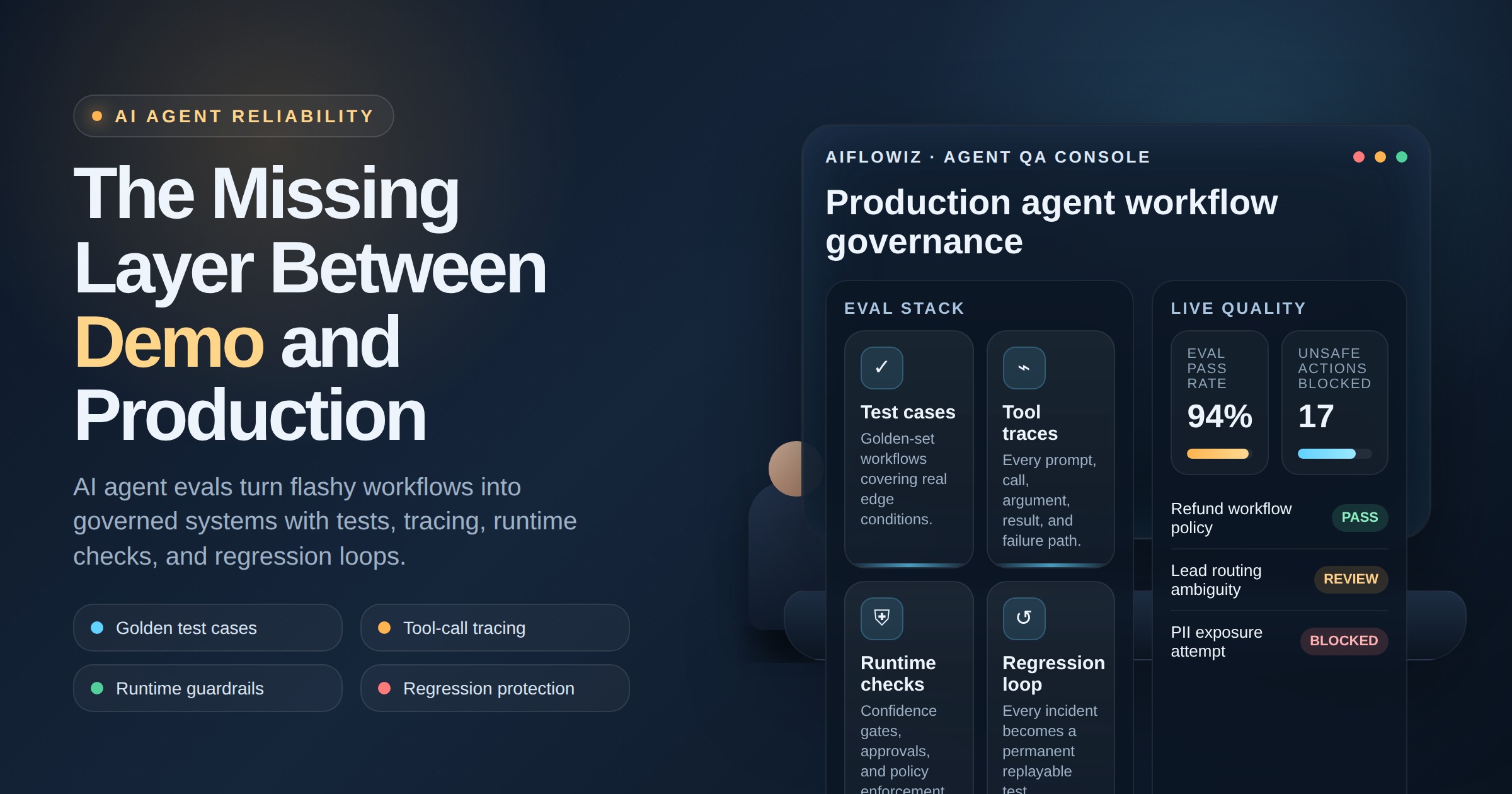
- Control layer — permission scopes, approval gates, cost caps, retries, logs, and human handoff rules.
AIflowiz typically builds this as a small production workflow first: one process, one owner, one measurable bottleneck. n8n or a lightweight backend coordinates the tools, while the agent handles judgment-heavy steps such as classification, summarization, routing, and exception explanation.
ROI: measure cycle time, not model cleverness
The ROI comes from reducing waiting time and rework. If a five-person ops team spends 90 minutes per day chasing approvals, copying updates, and clarifying missing context, a bounded handoff agent can recover 25–40 hours per month before any advanced autonomy is introduced.
- Pick one recurring handoff that happens at least 20 times per week.
- Measure current delay, touches, and error rate.
- Automate routing and context gathering first.
- Add agent decisions only where rules are too brittle.
- Review logs weekly and expand only after the workflow holds.
Risks and guardrails: keep actions bounded
The failure mode is giving an agent broad tool access before the workflow is stable. A handoff agent should not invent discounts, approve refunds, delete records, or message customers without policy boundaries. It should act inside a narrow permission set and escalate anything uncertain.
- Use read-only access before write access.
- Require approval for customer-facing or financial actions.
- Log every input, decision, tool call, and output.
- Set cost caps and rate limits by workflow.
- Run evals against past edge cases before expanding scope.
What AIflowiz would build first
A strong 7-day PoC is an agent that watches one pipeline, gathers missing context, drafts the next action, updates the system of record, and escalates exceptions to the right human. The scope is small enough to ship quickly and important enough to prove ROI.
If your team loses time between Slack, CRM, email, spreadsheets, and internal tools, start with the handoff instead of the model. Book a free AI audit or 7-day AI automation PoC with AIflowiz, and we will map the workflow, define safe boundaries, and ship the first controlled agent.