Long-Context AI Agents: The Context Window Is Not a Workflow
Long-context coding agents can inspect more of your system, but they still need boundaries, evals, logs, and human handoffs. The workflow around the model determines whether speed becomes leverage or operational debt.

Better coding models make demos look effortless. Production work still breaks at the same place: the handoff between generated code, business context, test coverage, review, deployment, and ownership.
The real bottleneck is not code generation
Long-context and agentic coding models can inspect more files, reason across larger systems, and produce working changes faster than a developer starting from a blank editor. That is useful, but it does not automatically create a reliable software delivery workflow.
The failure mode shows up after the impressive output. A model can open a pull request, but who confirms the requirement? Who checks the edge case? Who owns the rollback if the change touches billing, permissions, or customer data?
For founders and CTOs, the question is no longer, “Can AI write code?” The better question is, “Can AI move work through our engineering system without creating invisible risk?”
Where stronger models still fail in the workflow
A bigger context window reduces one class of failure: missing information. It does not remove workflow failure. Most teams still need explicit controls around what an agent can see, what it can change, and when a human must approve the next step.
The production gap usually appears in four places:
- Requirement drift: the agent solves the prompt, not the actual business constraint.
- Test illusion: generated tests validate the happy path while ignoring the dangerous path.
- Permission creep: the agent gains access to tools before the team defines safe boundaries.
- Review overload: humans receive large AI-generated diffs without enough traceability to review quickly.
A coding agent should not be treated like a faster freelancer. It should be treated like a new workflow actor that needs permissions, logs, evaluation rules, and escalation paths.
A practical architecture for coding agents
A production-ready coding agent workflow has more than a model endpoint. It needs an operating layer around the model.
A useful architecture looks like this:
- Intake layer: tickets, user stories, bug reports, or support requests are normalized into clear implementation tasks.
- Context layer: the agent receives bounded repo context, product docs, API contracts, and recent incidents — not unlimited access by default.
- Action layer: the agent can draft code, run tests, update docs, and open pull requests inside controlled tool permissions.
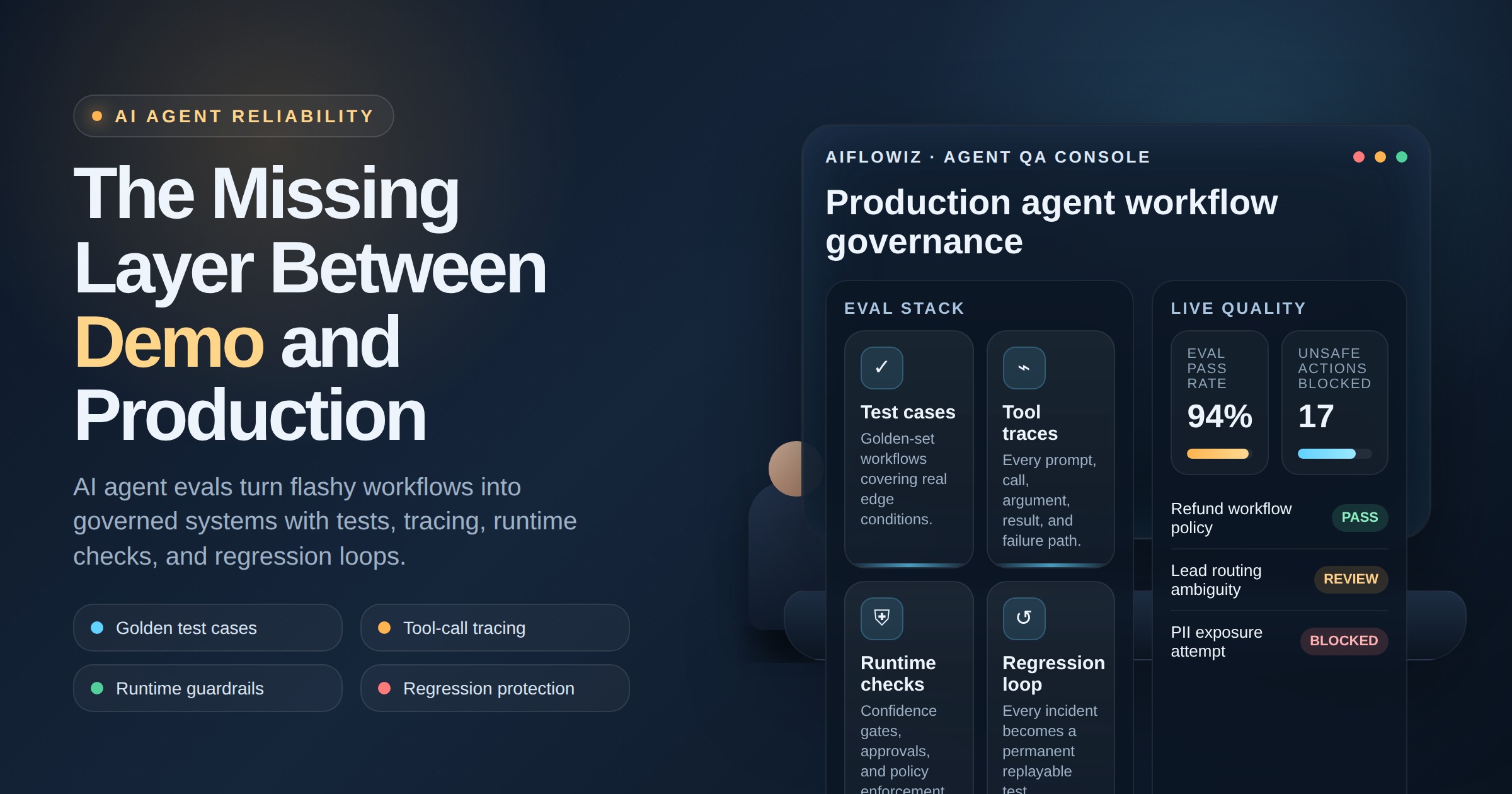
- Evaluation layer: changes are checked against unit tests, integration tests, security rules, style rules, and business-specific acceptance checks.
- Handoff layer: high-risk changes go to the right human reviewer with a summary, diff explanation, failed checks, and rollback notes.
That last layer is where most AI coding pilots are weakest. They focus on producing the diff, not moving the diff safely through the business.
ROI comes from cycle time plus fewer dropped handoffs
The ROI case is not “replace engineers.” That is usually the wrong model. The better ROI comes from reducing the time engineers spend on repetitive setup, boilerplate, test scaffolding, documentation updates, and first-pass investigation.
For a growing team, the measurable outcomes are practical:
- shorter PR cycle times for routine changes;
- fewer tickets stuck between product, engineering, and QA;
- faster reproduction of bugs from logs or support transcripts;
- more consistent documentation and test coverage;
- less senior-engineer time spent explaining the same system boundaries.
If a team ships ten small workflow improvements per week instead of six, the business feels it. If incidents become easier to trace because every agent action is logged, the ops team feels it too.
Guardrails that matter before scale
The highest-risk coding agent is not the one that makes a syntax error. It is the one that makes a plausible change in the wrong part of the system.
Before scaling agentic coding work, define guardrails such as:
- repo and file-level access boundaries;
- tool permissions by task type;
- cost and runtime caps;
- required tests before PR creation;
- human approval for production, billing, auth, data export, and customer-facing changes;
- audit logs that show prompt, context, tools used, files changed, and evaluation results;
- rollback notes attached to each high-risk change.
These controls do not slow the system down. They make speed usable.
What to build first
Start with one narrow workflow where the risk is controlled and the value is obvious. Good first candidates include bug reproduction, test generation for known modules, documentation maintenance, internal tooling, and first-pass refactors behind strong review rules.
Do not start by giving an agent broad repo access and asking it to “improve the codebase.” Start by designing the workflow boundary: what goes in, what actions are allowed, what checks must pass, and where humans take over.
AIflowiz builds production AI agent workflows with tool permissions, evals, logs, approval gates, and handoff rules. If your team wants to test coding agents without turning your repo into an experiment, book a free AI audit or a 7-day AI automation PoC.