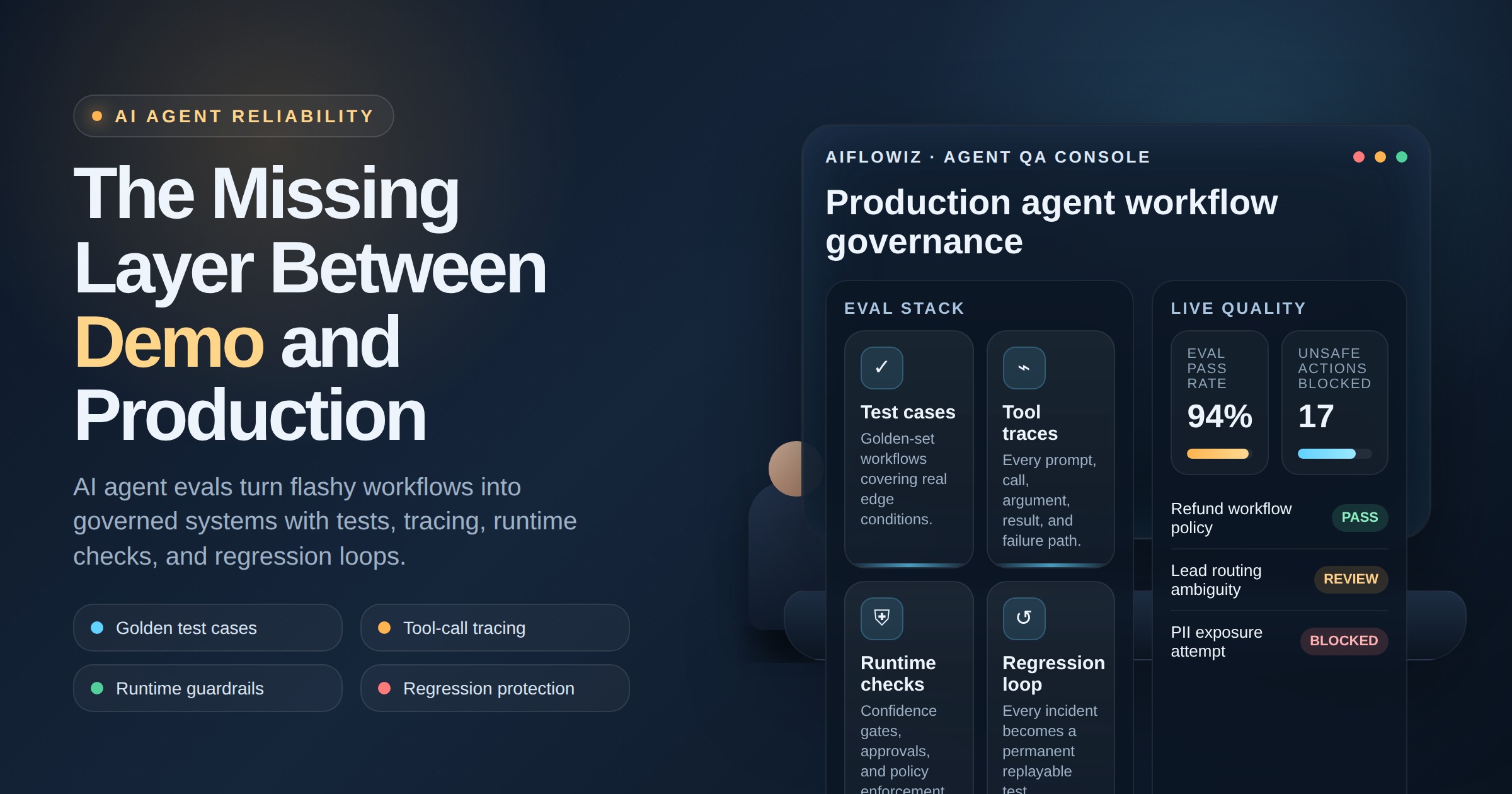
How to Pick Your First AI Automation Workflow in 2026
Most companies pick AI projects backwards: they start with a model instead of a bottleneck. This guide shows how to choose one workflow that can ship fast, prove ROI, and become the foundation for a larger AI system.

The best first AI workflow is boring, measurable, and painful enough that people already work around it manually. The mistake is chasing the flashiest demo. The win is finding the repeated handoff where data gets copied, checked, rewritten, approved, and chased every day.
Start With the Bottleneck, Not the Model
A useful AI automation starts where work is already expensive. Look for processes with clear inputs, repeated decisions, predictable outputs, and a human owner who can confirm whether the result is right. That is how you avoid building a clever bot nobody trusts.
- Customer support triage: classify tickets, draft answers, escalate edge cases.
- Sales qualification: score inbound leads, enrich context, route high-intent buyers.
- Document operations: extract fields from invoices, contracts, KYC files, or claims.
- Internal reporting: summarize CRM, spreadsheet, and warehouse data into daily decisions.
If the workflow cannot be measured in hours saved, response time reduced, errors avoided, or revenue captured, it is not the first workflow. It may be interesting, but it is not the wedge.
Score Each Candidate Like an Operator
AIflowiz evaluates first-workflow candidates with a simple filter: frequency, pain, data access, failure cost, and integration difficulty. High frequency plus low failure cost is the sweet spot. That combination lets a company ship quickly without betting the business on an unproven system.
- List 10 repetitive workflows your team touches every week.
- Estimate weekly hours lost, delay created, or revenue leaked by each workflow.
- Check whether the required data already exists in tools like Slack, HubSpot, Sheets, Notion, email, or a database.
- Remove workflows where one wrong answer creates legal, financial, or safety risk.
- Pick the highest-pain workflow that can be piloted with human approval in the loop.
Design the First Version as a Guarded System
The first version should not be a fully autonomous black box. It should be a guarded workflow: trigger, retrieve context, run the model, validate the output, log the decision, and route uncertain cases to a human. This is how AI moves from demo to production without creating chaos.
- Integrations: connect the tools where work already happens instead of forcing a new dashboard.
- Memory and context: use RAG or structured retrieval for company-specific policies, records, and examples.
- Guardrails: add confidence checks, allowlists, human handoff, rate limits, and cost caps.
- Observability: track inputs, outputs, errors, latency, model cost, and human overrides.
The goal of a 7-day proof of concept is not perfection. The goal is evidence: can this workflow save real time, reduce handoffs, and earn enough trust to expand?
Know When the Workflow Is Ready to Scale
A workflow is ready to scale when users stop treating it as a toy and start relying on it as part of the operating rhythm. That usually means the system handles common cases, explains uncertain cases, and makes it easy for humans to correct the output.
- Adoption: team members use it without being reminded.
- Accuracy: common cases are right often enough to save time after review.
- Safety: bad outputs are caught before they reach customers or critical systems.
- Economics: model and infrastructure cost are small compared with the operational value created.
Book a free AI audit with AIflowiz if you want a practical shortlist of workflows, a 7-day proof-of-concept plan, and a production architecture with integrations, guardrails, evals, and monitoring built in from day one.