AI Ops for Agents: Evals, Monitoring, and Cost Caps in 2026
Production agents fail quietly unless teams measure tool use, outputs, costs, and handoffs. AI Ops turns agents from clever demos into governed systems the business can trust.

Most agent failures do not look dramatic. They look like a slightly wrong CRM update, a tool call that ran twice, a support answer that skipped policy, or a model bill that nobody noticed until Friday. In production, agent behavior needs an operations layer before it needs a bigger model.
The Business Pain: Demos Do Not Create Accountability
Teams can now build agents that search knowledge bases, call APIs, summarize tickets, update records, and trigger workflows. The problem is that many of those agents ship with almost no visibility. When performance drops, the business cannot tell whether the model, prompt, retrieval, tool, data, or user input caused the issue.
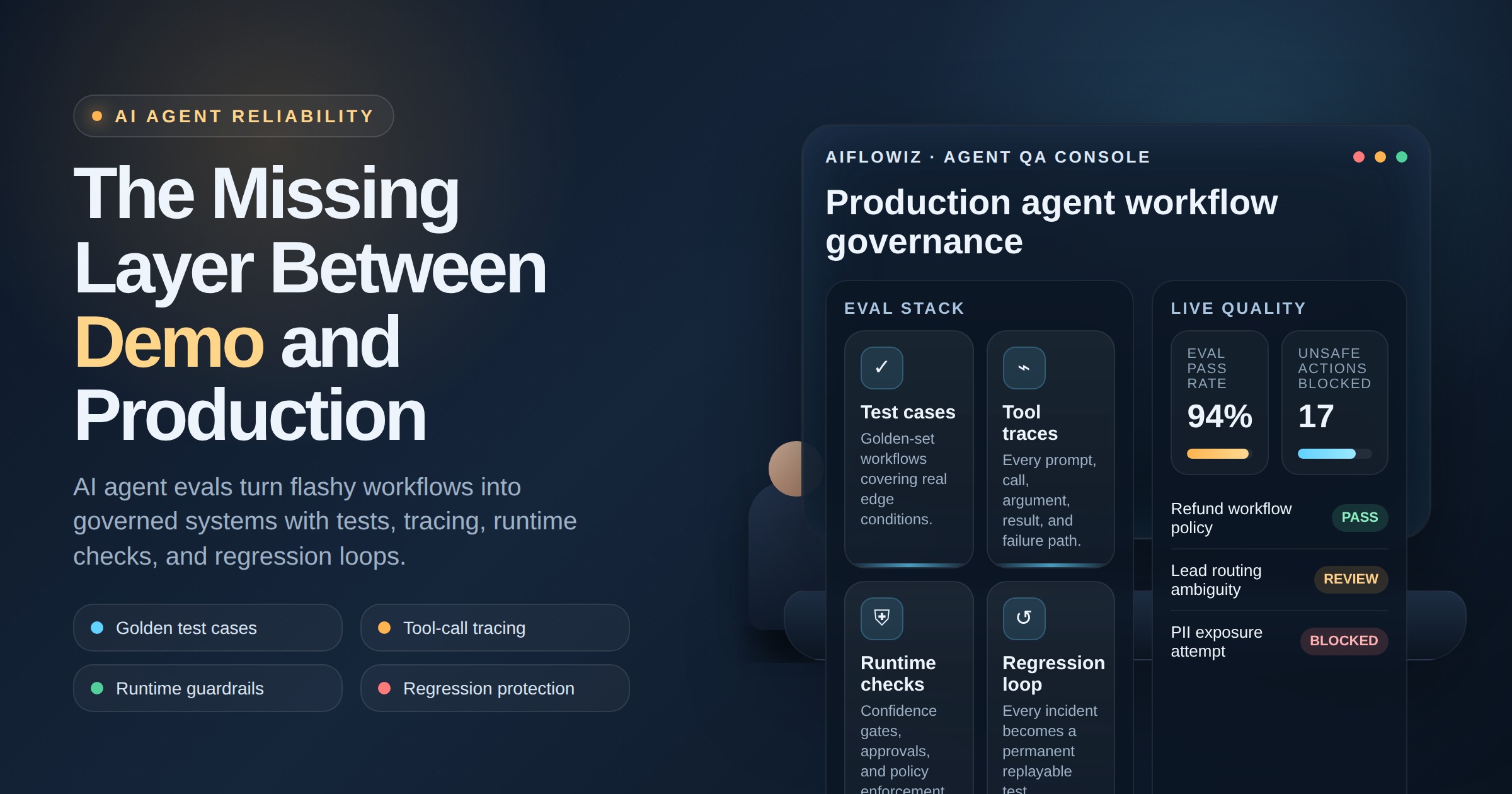
The AI opportunity is to treat agents like production services. That means logs, traces, evals, alerts, budgets, release gates, and rollback paths. AIflowiz designs this layer so leaders can see whether agents are saving time, creating risk, or quietly drifting.
The AI Ops Architecture for Production Agents
-
Tracing: capture prompts, retrieved context, tool calls, latency, model choice, and final actions.
-
Evals: run test cases for accuracy, policy compliance, tone, tool selection, and refusal behavior.
-
Monitoring: track failure rates, escalation rates, hallucination reports, and response quality over time.
-
Cost controls: route easy tasks to cheaper models, set per-user budgets, and alert on abnormal spend.
-
Human review: queue low-confidence or high-impact actions before they reach customers or systems of record.
This layer can sit around OpenAI, Anthropic, local models, LangGraph, n8n, custom Python services, RAG pipelines, and internal tools. The exact stack matters less than the operating discipline: every important agent decision should be observable, testable, and reversible.
Info: If an agent can write to a CRM, send a message, approve a document, or trigger a workflow, it needs tracing and policy checks before it gets broad access.
What to Measure Beyond Accuracy
Accuracy is necessary, but it is not enough. A support agent can be accurate and still too slow. A sales agent can be fluent and still fail to create qualified pipeline. A document agent can extract correctly but route exceptions poorly. AI Ops ties model behavior back to business outcomes.
-
Define the agent goal in operational terms: resolution, booking, qualification, extraction, routing, or update completion.
-
Create a small eval set from real edge cases, not synthetic happy paths only.
-
Track business KPIs beside AI metrics: handle time, automation rate, revenue touched, error cost, and human escalation rate.
-
Review failed traces weekly and turn them into prompt, retrieval, tool, or policy improvements.
{
  "trace_id": "agt_2026_05_18_0017",
  "task": "update_crm_after_discovery_call",
  "model": "gpt-4.1-mini",
  "tool_calls": 3,
  "cost_usd": 0.018,
  "policy_checks": ["pii_safe", "no_unapproved_discount"],
  "eval_score": 0.91,
  "human_review_required": false
}
Risks and Guardrails
The main risks are silent quality drift, prompt injection, runaway tool use, privacy leakage, and cost spikes. AIflowiz controls these with scoped credentials, allowlisted tools, retrieval filters, red-team prompts, regression evals, alerting, and staged rollout from shadow mode to human-in-the-loop to limited autonomy.
Warning: A safe agent launch has a kill switch, a spend limit, a human escalation route, and a dashboard that shows failures before customers do.
A Practical First AI Ops Sprint
Start with one live agent or workflow. Add trace capture, define 25 to 50 eval cases, set model and tool budgets, and create a weekly review loop. Within a week, the team should know where the agent succeeds, where it needs human backup, and which improvements will move business metrics.
If you already have an AI agent in production or a demo about to touch real customers, book a free AI audit with AIflowiz. We will review the workflow, map the risk surface, and design the evals, monitoring, and guardrails needed for a production build.